Posts

6 things you might not know about Frankenstein
Image
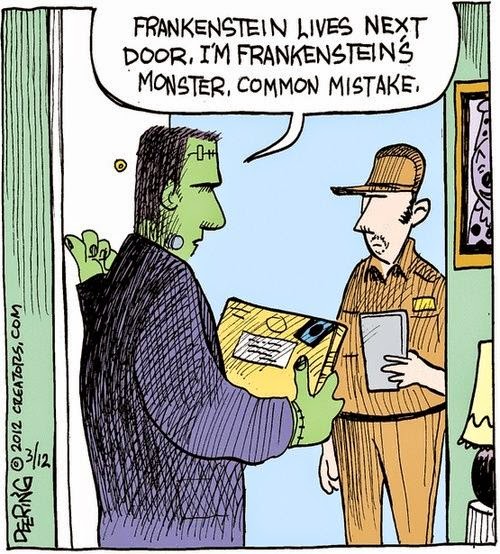
6 things you might not know about Frankenstein Who is Frankenstein ? If you hear the word, "Frankenstein" and you picture in your mind a green creature with bolts sticking out of his neck, well then you are confusing the monster with his master. In fact, Frankenstein is not a scientist, but a doctor who was obsessed with life and death. The death of his loved ones was the trigger that sparked the interest in giving life into something that was already dead. So I am sorry, but he is not a crazy scientist, although, he fits the archetype: An ambitious man focused on a grand scheme to change the world. Who is the Creature?  Now, if you were thinking that you only mistook the names of Frankenstein and the monster, but that the creature still looks the same, well you are wrong yet again. Frankenstein designed the monster to look beautiful. In the book, the doctor states when he looks at the creature:  "His limbs were in proportion, and I had selected hi...

"Does Listening to Mozart Increase the Intelligence of Babies?" Psychology Myths (Part 5 of 5)

Image
Myth #5 You can increase the intelligence of babies by playing Mozart's Music        These posts always start with a few samples of myth believers. In this case, it's 73% of psychology students, who were barely taking the introductory course, that were gullible enough to believe that Mozart's music affects intelligence (Taylor & Kowalski, 2003, p. 5). In addition, two surveys conducted by Bangerter & Heath (2004) found that over 80% of Americans were acquainted with the effect. History Once upon a time, in 1993 there was an article titled "Music and spatial task performance" in the journal "Nature." The article was about an experiment that looked at what happened after college students listened to a Mozart piano sonata for 10 minutes. The results were that the students displayed a short-term improvement in a spatial reasoning task (Rauscher, Shaw, KY, 1993). This article served as the basis for the Mozart Effect. (If you would like...

"Can Subliminal Messages Persuade People?" Psychology Myths (Part 4 of 5)

Myth #4 Subliminal Messages Can Persuade People to Purchase Products         Before starting, I want to make a distinction between influence and persuasion. To influence is to have an effect and to persuade is to cause someone to believe or to do something . Therefore, if I show you an advertisement that tells you to purchase a Coca-Cola and you buy a Pepsi instead, whereas you would not have bought a Pepsi before, then the ad had an influence on you, but it did not persuade you.  (If you w ould like to learn more about this and other myths check out  50 Great Myths of Popular Psychology  by clicking this link)        Similarly to other myths, this one is incredibly popular too. It's not surprising when laymen become entrapped to these types of misconceptions, but it becomes alarming when people starting their career think they are a valid phenomenon. In the case of subliminal messages persuading people, one study fou...

"Is the right side of the brain creative and the left academic?" Psychology Myths (Part 3 of 5)

Image
Myth #3   People are either left-brained or right-brained "I'm not good at Math. It's 'cause I'm right-brained." "I can't draw. Because, you know, I'm left-brained." Have you heard  these excuses before? They are invalid reasons because the brain is not split into a creative and an academic side . But before we tackle this myth, let's look at the real differences between the hemispheres. (If you would like to learn more about this and other myths check out  50 Great Myths of Popular Psychology  by clicking this link) Split Brain Procedure Functions are the main difference between hemispheres (Springer & Deutsch, 1997). How do we know that? Well, there are different methods to study the brain, some of the newest ones include conducting an e lectroencephalogram (EEG), a c omputerized axial tomography (CAT), a p ositron emission tomography (PET), and a f unctional Magnetic Resonance Imaging (fMRI), which are dep...

"Does Memory Accurately Record Events?" Psychology Myths (Part 2 of 5)

Image
Myth #2 Memory accurately records events we have experienced. “I was with the guys for a second, and I think I went over to look at the toy store, the Kay-Bee toys … we got lost, and I was looking around and I thought, ‘Uh-oh. I’m in trouble now.’ … I thought I was never going to see my family again. I was really scared, you know. And then this old man … came up to me … he was kind of bald on top … he had a like a ring of gray hair … and he had glasses … and then crying, and Mom coming up and saying, ‘Where were you? Don’t you ever do that again!’”  What is amazing about this story is not that the boy was lost, but that, even though a participant remembers the event clearly occurring, it never happened. This beautifully illustrates that memory is not an accurate source of information. Memories sometimes are altered, false, and forgotten.   ( If you would like to learn more about this and other myths check out  50 Great Myths of Popular Psychology  ...

"Do people use ten percent of their brain power?" Psychology Myths (Part 1 of 5)

Image
Myth #1 People Use Only 10% of Their Brain Power        A long time ago, I learned about the myth that people only use 10% of the brain. At first, I thought that only individuals who were not in the field of psychology or neurology would believe this misconception. However, this changed when I read a study that found that one-third of psychology students believed that people only use one-tenth of their brain power (Higbee & Clay, 1998, p. 471). Then, when people kept asking me what I thought about humans only being capable of using ten percent of their brain and reading similar articles like one that found that 59% of a sample of individuals who went to college in Brazil believe the ten percent myth and that six percent of neuroscientists agreed (Herculano-Houzel, 2002), I understood that I was reading about one of the most prevalent myths in psychology. (If you would like to learn more about this and other myths check out 50 Great Myths of Popula...

"Is Psychology a Science?" - Introduction to Psychology (Part 2)

Image
Short answer:   Yes. Long answer: Before answering, it is important to describe what science is, what its goals are, the requisites a field has to be a science, and to examine whether psychology can fulfill that criteria. What is Science?      Science is any field that follows the scientific method. This consists of five steps: making an observation/formulating a question, establishing a hypothesis, conducting a test, analyzing the data, and forming a conclusion.      In order to find out whether psychology undergoes the scientific method we will examine a research paper to check if psychologists do follow these steps.  The paper that will be examined comes from the journal Psychopharmacology , which is also the branch of psychology that deals with the effects of drugs. It is titled "Effects of 2-bromoterguride, a dopamine D2 receptor partial agonist, on cognitive dysfunction and social aversion in rats."      As menti...